The Qualities That Make Up A Musician
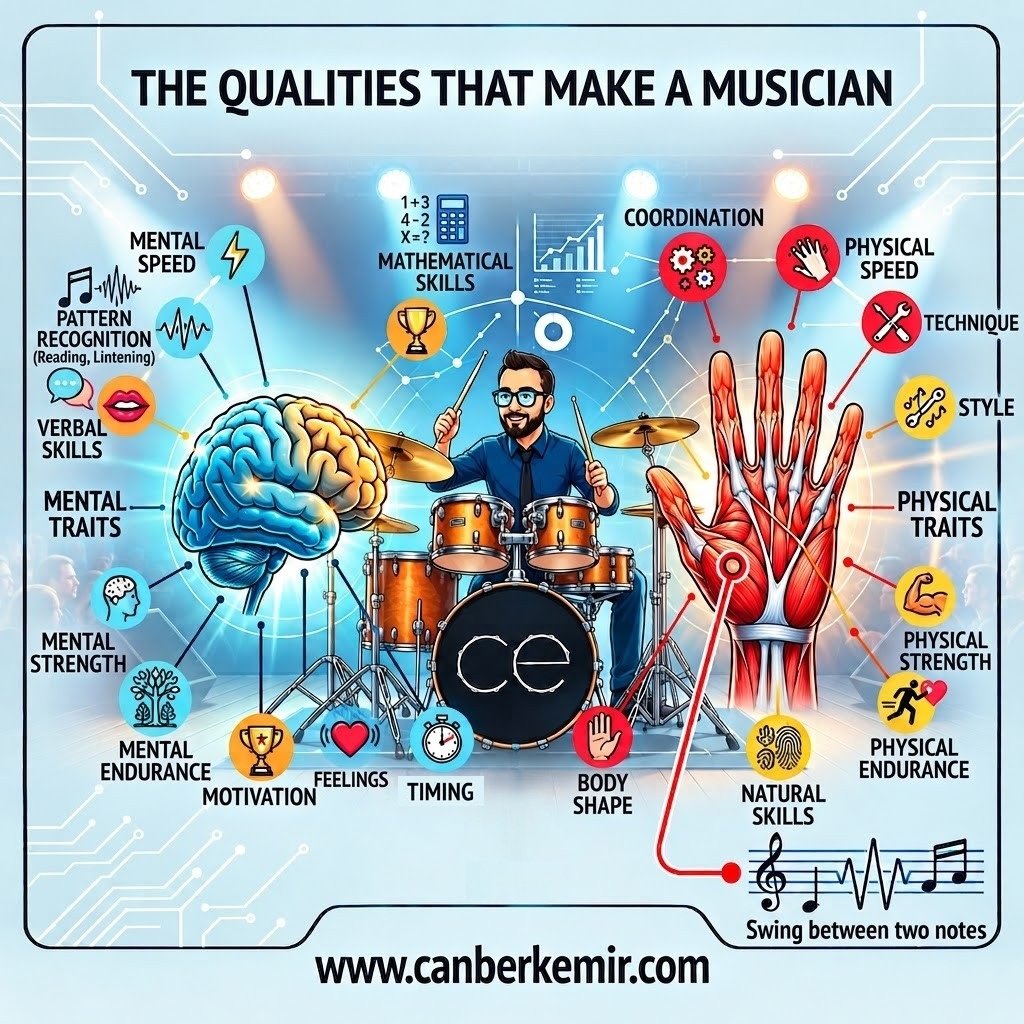
A musician's development cannot be explained solely by instrumental playing ability. Especially in a field like drumming—which simultaneously demands auditory perception, cognitive processing, motor coordination, timing, and physical performance—musical competence is the result of multiple systems working in unison.
A good musician is someone who accurately perceives what they hear, organizes it mentally, translates it into physical movement at the right moment, and sustains all of me within a musical expression. Therefore, musicianship must be evaluated as a synthesis of mental, emotional, and physical qualities.
Mental Speed
During music-making, the brain processes large amounts of information within very short time intervals. The musician perceives sound, recognizes rhythmic structure, anticipates the upcoming beat, and executes the corresponding motor movement.
Rapid perception and quick decision-making become particularly essential during improvisation, live performance, and ensemble interaction.
Pattern Recognition
Music is largely composed of repeating and interconnected patterns. Being able to recognize rhythmic patterns, melodic movements, harmonic progressions, and form structures allows musicians to comprehend music much faster.
A drummer perceiving a rhythm not as individual strokes, but as a holistic structure, is a prime example of pattern recognition. As this skill develops, the musician can more easily spot familiar relationships even within unfamiliar, complex structures.
Verbal Skills
Musicianship is not just about sounds. Rehearsals require explaining musical ideas, listening to other musicians, understanding musical terminology, and accurately interpreting feedback.
Especially in ensemble playing, communication skills are a vital part of musical performance. How well a musician can articulate what they are playing and why is just as important as the playing itself.
Mathematical Skills
Music is not strictly mathematics; however, relationships of proportion, division, duration, repetition, and timing are constantly applied within it.
Time signatures, note values, subdivisions, polyrhythms, odd meters, and various rhythmic groupings require organizing specific mathematical relationships musically.
In drumming specifically, the ability to divide time into different segments facilitates the understanding and execution of complex rhythmic structures.
Mental Fortitude
Musical development is a long-term process. Developing a technique, solidifying coordination, or cleanly executing a complex passage often requires lengthy, repetitive practice.
Mental fortitude does not mean making no mistakes. It means being able to refocus after an error, continuing to practice despite failed attempts, and staying committed to long-term goals.
Particularly during live performances, it is crucial for a musician to recover quickly after a mistake and redirect their focus to the continuation of the music.
Mental Resilience
Growth in musicianship is not always linear. While progress may feel rapid during certain phases, it can seem exceedingly slow during others.
At this stage, patience and consistency become paramount. Mental resilience is the capacity to maintain concentration under performance pressure and sustain long-term practice routines.
Motivation
Musical practice often demands repetition. Rudiments, coordination exercises, metronome work, and repertoire repetition are continually revisited.
Motivation is a key trigger for initiating this process, but long-term progress requires discipline and strong practice habits alongside motivation.
A musician may not have the same level of motivation every day. Therefore, establishing a sustainable practice system is far more effective than relying on motivation alone.
Feelings